Stress often follows us long after the day is over.
The laptop may be closed. The phone may be on silent. The lights may be off.
But the mind is still busy.
Work conversations replay. Tomorrow’s tasks appear. The body feels tired, yet sleep does not come easily.
This is where a simple yoga practice for stress relief and better sleep can become useful.
Yoga does not need to be intense or complicated at the end of the day. In fact, a slower practice is often more suitable when your goal is relaxation.
Gentle movement, breathing and mindful awareness can help the body shift away from constant activity and move toward rest.
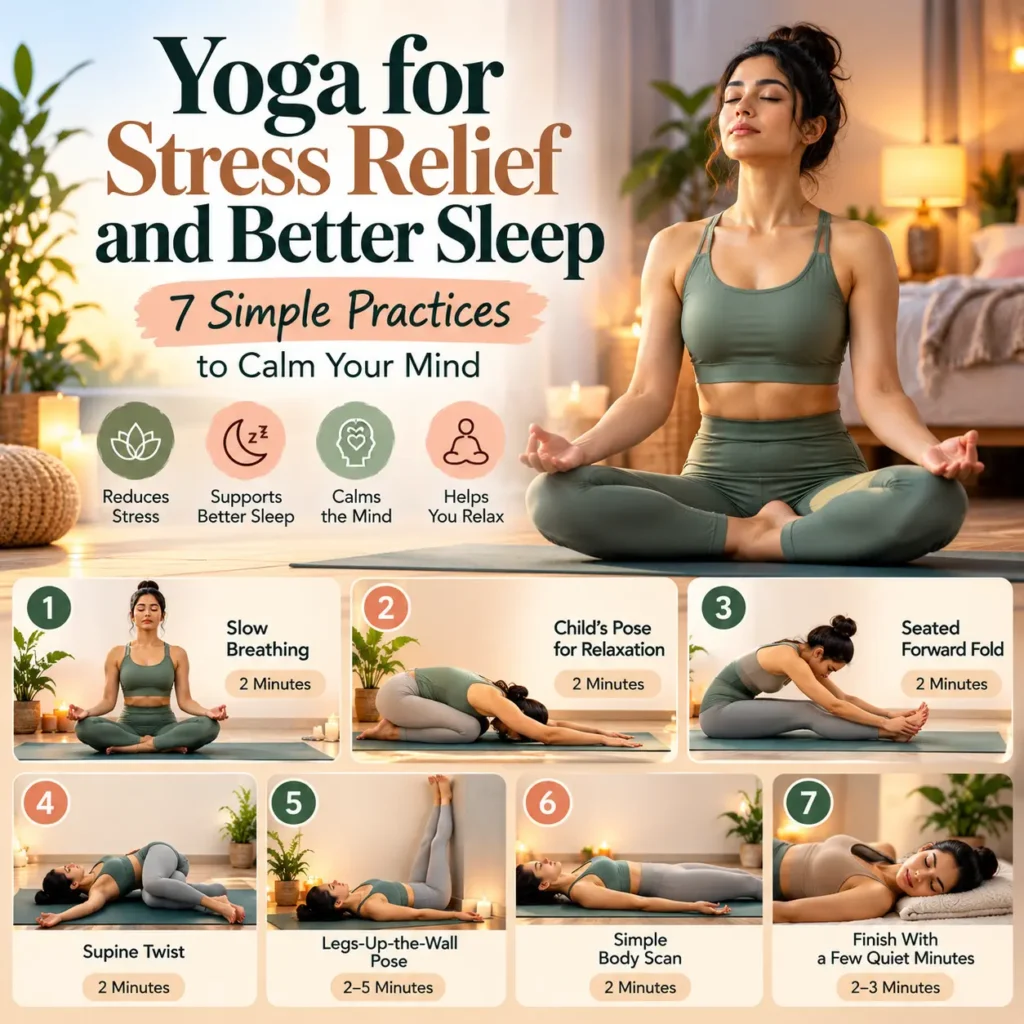
Here are seven simple yoga practices that can support a calmer evening routine.
1. Start With Slow Breathing
Before doing any pose, begin with your breath.
Sit or lie down comfortably.
Close your eyes if that feels natural.
Inhale slowly through the nose.
Exhale gently.
Do not try to force an extremely deep breath.
Instead, focus on making the breath smooth and steady.
A few minutes of conscious breathing can help you notice how much tension your body has been holding.
You may realise that your shoulders are lifted.
Your jaw may be tight.
Your stomach may feel tense.
Breathing gives the body a chance to soften.
2. Child’s Pose for Relaxation
Child’s Pose is one of the most comforting postures in yoga.
Come onto your hands and knees.
Slowly move your hips back toward your heels.
Extend your arms forward or rest them beside your body.
Allow your forehead to relax toward the mat.
If reaching the floor is uncomfortable, place a cushion under your forehead.
Stay for several slow breaths.
The purpose of this posture is not flexibility.
It is rest.
Child’s Pose can help create a feeling of safety and stillness, which is useful after a busy or mentally demanding day.
3. Seated Forward Fold
Sit with your legs extended comfortably in front of you.
You may keep a slight bend in your knees.
As you exhale, gently lean forward.
Do not try to reach your feet.
Rest your hands wherever they naturally reach.
The thighs, knees or shins are all fine.
Allow the head and shoulders to soften.
Forward folds are often used in slower yoga practices because they naturally encourage a quieter pace.
Avoid pulling yourself deeper into the pose.
Relaxation works better when the body does not feel forced.
4. Supine Twist
Lie on your back with your knees bent.
Let both knees slowly move to one side.
Keep your shoulders comfortable on the floor.
Turn your head in the opposite direction if that feels pleasant.
Stay for several breaths.
Then switch sides.
A gentle spinal twist can feel especially good after a day spent sitting.
It may help release tension around the waist, hips and back while allowing the body to relax into the floor.
5. Legs-Up-the-Wall Pose
This is one of the easiest poses to include in a bedtime yoga routine.
Sit beside a wall.
Carefully lie down and extend your legs upward.
Your hips do not need to touch the wall.
Choose a distance that feels comfortable.
Rest your arms beside you.
Stay for a few minutes.
Breathe slowly.
This pose requires very little effort, making it a good option when you feel physically tired but mentally restless.
It gives you an opportunity to be still without immediately trying to fall asleep.
6. Try a Simple Body Scan
Yoga does not always need movement.
Lie comfortably on your back.
Close your eyes.
Bring your attention to your feet.
Notice how they feel.
Then slowly move your attention upward.
Calves.
Knees.
Thighs.
Hips.
Stomach.
Chest.
Shoulders.
Hands.
Face.
There is nothing you need to change.
Simply notice.
This practice can help move attention away from repetitive thoughts and back into the present moment.
Many people find that this naturally encourages relaxation.
7. Finish With a Few Quiet Minutes
At the end of your yoga practice, avoid immediately picking up your phone.
Stay still for two or three minutes.
Let your breathing return to normal.
Notice your body.
Notice the room.
Allow the practice to end gradually.
This small transition matters.
If you move straight from relaxation into emails, social media or bright screens, the mind can quickly become active again.
Give yourself a few quiet minutes before moving toward sleep.
How Yoga Can Support Stress Relief
Stress is not only mental.
The body often responds to stress physically.
You may experience:
- Tight shoulders
- Shallow breathing
- Headaches
- Jaw tension
- Stiffness
- Restlessness
- Difficulty switching off at night
A mindful yoga practice can help you become aware of these signals earlier.
You may begin noticing tension before it becomes overwhelming.
Instead of waiting until you feel completely exhausted, you can use breathing or gentle movement as a way to reset.
Yoga does not remove the responsibilities that create stress.
But it can support a healthier response to them.
Can Yoga Help With Better Sleep?
A calming yoga routine before bed may help create a more consistent transition between activity and sleep.
The key is choosing gentle practices.
Late at night is usually not the time for an intense workout if your goal is relaxation.
Focus instead on:
- Slow breathing
- Gentle stretches
- Restorative poses
- Quiet awareness
- Reduced screen time
Over time, your brain may begin associating this routine with winding down.
Consistency can make the routine more effective.
Create a Simple 10-Minute Bedtime Yoga Routine
You do not need a long session.
Try this:
2 minutes: Slow breathing
2 minutes: Child’s Pose
2 minutes: Supine Twist
2 minutes: Legs-Up-the-Wall
2 minutes: Quiet body scan
That is enough.
If you have more time, stay longer.
If you have less time, simply practise breathing and one restorative posture.
A short routine you actually follow is more useful than a complicated routine you keep postponing.
Avoid Turning Relaxation Into Another Task
This is important.
Yoga for stress relief should not become another thing you feel pressure to “complete.”
You do not need perfect timing.
You do not need perfect poses.
You do not need to track every session.
Some evenings you may practise for twenty minutes.
Other evenings you may lie down and breathe for five.
Both can be valuable.
The purpose is to create more calm, not more pressure.
Small Changes Outside the Yoga Mat
Your evening yoga practice can work even better when combined with a few simple habits.
Try reducing bright screen use shortly before bed.
Dim the lights when possible.
Avoid carrying work into the final minutes of the day.
Keep your sleeping space comfortable.
And if your mind feels busy, write down tomorrow’s important tasks before beginning yoga.
Sometimes the mind relaxes more easily when it knows it does not have to remember everything.
Final Thoughts
Yoga for stress relief and better sleep does not need to involve complicated sequences.
The most effective practice may simply be the one that helps you slow down.
Breathe.
Move gently.
Notice tension.
Give yourself a few quiet minutes.
Then allow the day to end.
Rest is not wasted time. It is part of how the body and mind prepare for everything that comes next.