Back pain has become a common part of modern life.
Long hours at a desk, poor sitting habits, limited movement, stress and even the way we use our phones can all contribute to stiffness around the spine, hips and shoulders.
While yoga is not a replacement for medical treatment, a gentle and mindful practice can help many people improve mobility, reduce everyday stiffness and become more aware of how they move.
The key is not to stretch harder.
The key is to move better.
A simple yoga routine for back pain relief can focus on mobility, breathing, posture and gradual strengthening without forcing the body.
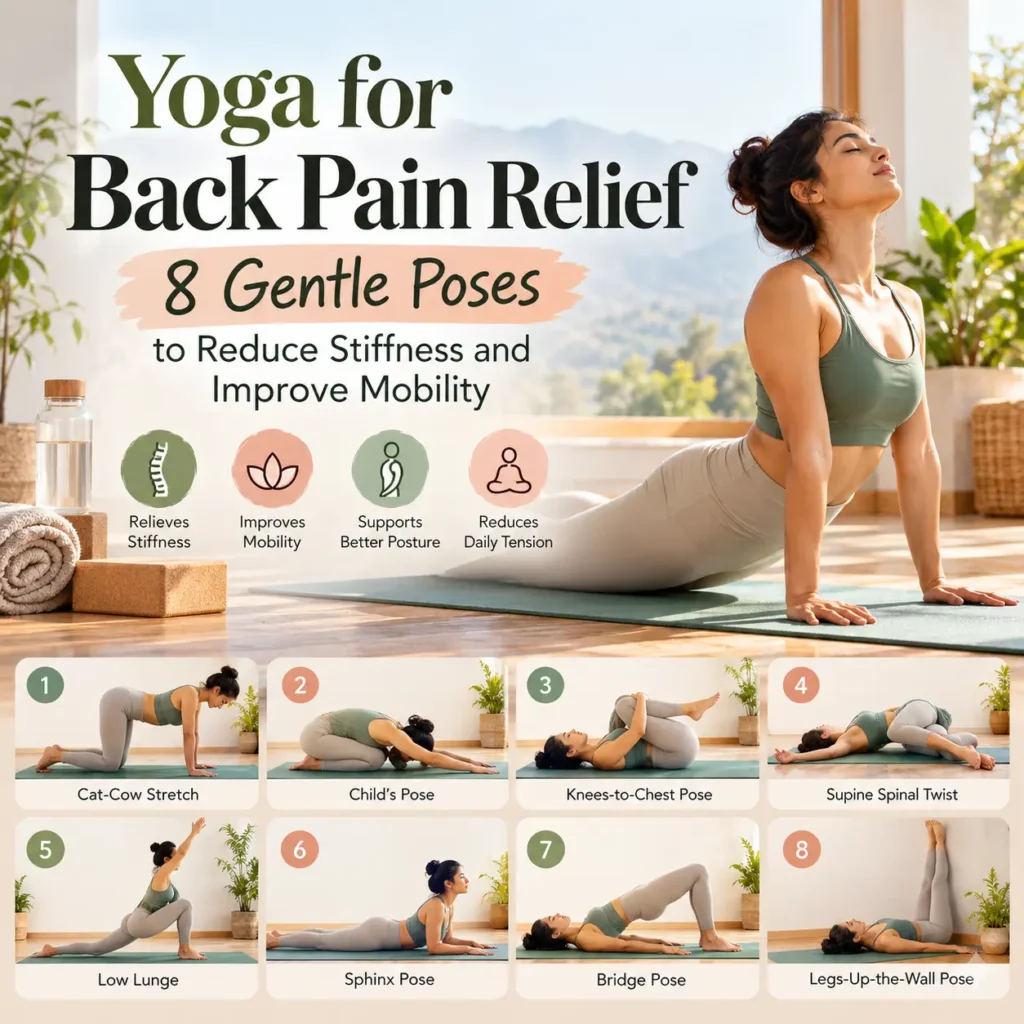
Here are eight gentle yoga poses that can be useful for people dealing with everyday back stiffness.
1. Cat-Cow Stretch
Cat-Cow is one of the simplest ways to introduce movement into the spine.
Come onto your hands and knees.
Place your hands under the shoulders and knees under the hips.
As you inhale, gently lift the chest and allow the spine to arch comfortably.
As you exhale, round the back and let the head relax forward.
Move slowly between the two positions.
This movement helps the spine flex and extend in a controlled way and can reduce the feeling of stiffness after long periods of sitting.
Avoid forcing the lower back into a deep arch.
Keep the movement smooth and comfortable.
2. Child’s Pose
Child’s Pose is often used as a resting posture in yoga.
From hands and knees, slowly move your hips back toward your heels.
Extend the arms forward or keep them beside the body.
Let the forehead rest on the mat or a cushion.
Take slow breaths.
This position can help create space through the lower back and hips while encouraging the body to relax.
If the hips do not comfortably reach the heels, place a cushion under them.
Comfort is more important than depth.
3. Knees-to-Chest Pose
Lie comfortably on your back.
Bring both knees toward your chest.
Hold the legs gently and allow the lower back to relax toward the floor.
You can stay still or slowly rock from side to side.
This is a simple movement that can feel especially soothing after a long day of sitting.
Avoid pulling the knees aggressively.
The movement should feel supportive rather than intense.
4. Supine Spinal Twist
While lying on your back, bend your knees.
Let both knees slowly move toward one side while keeping the shoulders relaxed.
Turn the head in the opposite direction if that feels comfortable.
Stay for several breaths and then repeat on the other side.
Gentle twists can help improve spinal mobility and release tension around the back and waist.
Do not force the knees toward the floor.
Let gravity do most of the work.
5. Low Lunge
Tight hips can sometimes contribute to discomfort around the lower back.
A Low Lunge can help stretch the front of the hips.
Step one foot forward and allow the back knee to rest on the mat.
Keep the front knee comfortably bent.
Place the hands on the front thigh or yoga blocks.
Gently shift the hips forward until you feel a mild stretch through the hip of the back leg.
Keep the chest lifted and avoid collapsing into the lower back.
Repeat on both sides.
6. Sphinx Pose
Lie on your stomach.
Place your elbows under the shoulders and forearms on the floor.
Gently lift the chest.
Keep the shoulders relaxed and avoid pushing aggressively into the hands.
Sphinx Pose introduces a mild backbend and can help encourage movement through the front of the body.
If you feel compression or pain in the lower back, come out of the pose.
The posture should feel gentle.
7. Bridge Pose
Lie on your back with the knees bent and feet on the floor.
Keep your feet about hip-width apart.
Press gently into the feet and slowly lift the hips.
Keep the chest relaxed and avoid over-arching the lower back.
Hold for a few breaths before lowering down slowly.
Bridge Pose can help strengthen the glutes and muscles around the hips, which play an important role in supporting the lower back.
Strength and mobility work best together.
8. Legs-Up-the-Wall Pose
Sit close to a wall and carefully lie back while extending the legs upward.
Allow your arms to relax beside you.
Stay for a few minutes and breathe slowly.
This restorative posture can help the body settle after movement.
It is especially useful in the evening when your back and legs feel tired after a long day.
You do not need to push the hips directly against the wall.
Choose a position that feels comfortable.
Why Back Pain Is Not Always About the Back
One important thing to understand is that back discomfort can sometimes be influenced by other areas of the body.
Tight hips, weak glutes, poor posture, limited thoracic mobility and long periods of inactivity can all change the way the spine moves.
That is why an effective yoga routine should not focus only on stretching the lower back.
It should also include the hips, shoulders, core and breathing.
The body works as a connected system.
Breathing Matters More Than You Think
When people experience discomfort, they often tense the body without realising it.
The shoulders lift.
The jaw tightens.
The breath becomes shallow.
Slow breathing during yoga can help reduce unnecessary tension and encourage more relaxed movement.
Try to breathe naturally throughout each pose.
If you find yourself holding your breath, that may be a sign you are pushing too hard.
How Often Should You Practise?
You do not need a long yoga session every day.
A short 10- to 15-minute routine can be enough to keep the body moving.
Consistency usually matters more than intensity.
For example, you might practise:
- Cat-Cow
- Child’s Pose
- Low Lunge
- Bridge Pose
- Supine Twist
A short routine like this can fit easily into the morning, after work or before bed.
What to Avoid
Yoga should not create sharp or increasing pain.
Avoid forcing deep forward bends, strong twists or intense backbends when the body already feels irritated.
Move slowly and stay within a comfortable range.
If your pain is severe, persistent, follows an injury, or is accompanied by symptoms such as numbness, weakness or pain travelling down the leg, it is important to seek professional medical advice before relying on exercise.
Final Thoughts
Yoga for back pain relief does not need to involve complicated poses.
Simple, controlled movement can often be more useful.
The goal is to improve mobility, reduce stiffness, support better posture and help the body move with less tension.
Start slowly.
Pay attention to your breathing.
Do not force flexibility.
And focus on consistency rather than intensity.
Your back does not always need a harder stretch. Sometimes, it simply needs regular movement, better support and a little more attention.